
Why confidence without competence is the silent risk in quality engineering
Software testing is not just a technical activity. It is deeply human.
Behind every missed bug, false confidence in coverage, rushed release, or production incident, there is often not just a technical gap, but a cognitive one. One of the most powerful psychological patterns influencing software quality today is the Dunning–Kruger Effect, a phenomenon that quietly shapes decisions, team dynamics, and delivery outcomes.
Understanding it can transform how we build, test, and ship software.
More importantly, it can transform how we grow as testers.
What Is the Dunning–Kruger Effect?
The Dunning–Kruger Effect was identified by psychologists David Dunning and Justin Kruger. Their research revealed a fascinating and uncomfortable truth:
People with low competence in a domain tend to overestimate their ability, while highly competent individuals often underestimate theirs.
Why does this happen?
Because the skills required to perform well are often the same skills required to evaluate performance. When someone lacks knowledge, they cannot recognize their own gaps.
In software testing, this cognitive bias appears everywhere — in test design, automation strategies, quality metrics, risk assessment, and even in leadership decisions.
And its consequences can be expensive.
Why Software Testing Is Highly Vulnerable to This Effect
Testing sits at the intersection of uncertainty, complexity, and judgment. Unlike development tasks with clear outputs, testing requires:
- Critical thinking
- Risk analysis
- Domain understanding
- Exploratory curiosity
- Systems thinking
- Humility about what we don’t know
This makes testing uniquely susceptible to misplaced confidence.
Let’s explore where this shows up in real delivery environments.
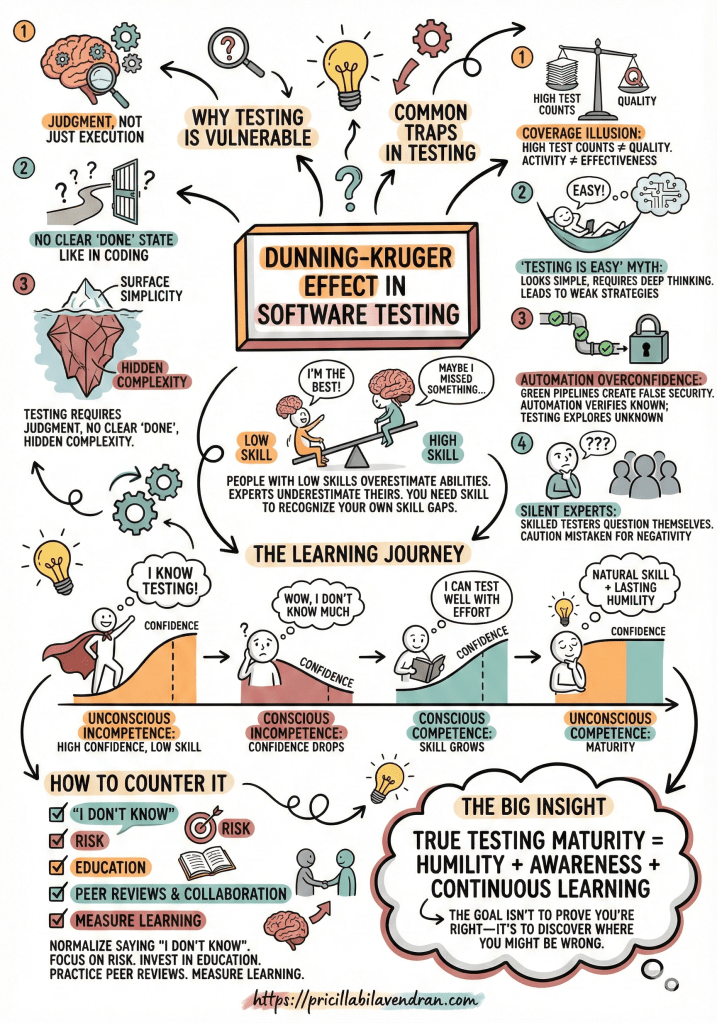
1. The Illusion of Test Coverage
One of the most common manifestations of the Dunning–Kruger Effect in testing is the belief that:
“We tested everything.”
Teams often equate:
- High test case count
- Automation percentage
- Code coverage metrics
with product quality.
But numbers are comforting illusions.
A team may execute thousands of test cases yet miss critical user flows. Automation suites may pass while usability collapses. Coverage may reach 90% while real risks remain untested.
Early-stage testers or immature teams frequently assume that activity equals effectiveness. They mistake execution for insight.
Experienced testers, however, live with a different reality:
They know software is never fully tested.
The more you learn about testing, the more you realize how much remains unknown.
2. “Testing Is Easy” — The Most Dangerous Assumption
Many organizations underestimate testing because it appears straightforward:
- Run the application
- Click around
- Verify output
But real testing demands deep thinking:
- What could fail silently?
- What assumptions exist?
- Where are hidden dependencies?
- What user behavior was never imagined?
- What data combinations could break the system?
When people lack testing expertise, they often assume expertise is unnecessary.
This leads to:
- Minimal test strategy
- Weak risk analysis
- Late involvement of QA
- Overconfidence in quick validation
Ironically, the more complex the system, the more dangerous this assumption becomes.
3. The Automation Confidence Trap
Automation brings tremendous value: speed, repeatability, and consistency. But it also introduces a powerful Dunning–Kruger trap.
Early automation success can create inflated confidence:
- “We automated the regression suite.”
- “The pipeline is green.”
- “Quality is ensured.”
What gets ignored?
- Poorly designed tests
- Fragile assertions
- Missing edge cases
- False positives
- False sense of safety
Automation amplifies whatever thinking created it: good or bad.
Without strong testing fundamentals, automation simply accelerates shallow testing.
Mature testers understand this deeply:
Automation verifies known expectations. Testing explores the unknown.
4. The Silent Voice of Experienced Testers
An interesting side of the Dunning–Kruger Effect is that highly skilled individuals often underestimate themselves.
In testing teams, this shows up as:
- Quiet but insightful engineers
- Testers who constantly question their own work
- Professionals who highlight risks others ignore
- Experts who say “we might be missing something”
Unfortunately, their caution may be interpreted as negativity or a lack of confidence.
Organizations sometimes reward loud certainty over thoughtful doubt.
But real quality comes from disciplined skepticism.
5. Leadership and Delivery Risks
The Dunning–Kruger Effect is not limited to individual testers. It affects leadership decisions as well.
Common patterns include:
- Unrealistic testing timelines
- Belief that “automation will solve everything”
- Underinvestment in exploratory testing
- Ignoring quality risk signals
- Equating speed with progress
When decision-makers lack testing understanding, they may unintentionally create delivery environments where quality becomes fragile.
Production incidents rarely originate from a single mistake, they grow from systemic overconfidence.
The Emotional Side of the Effect
Beyond process and delivery, the Dunning–Kruger Effect shapes human experience in teams.
It creates:
- Frustration for experienced testers
- Overconfidence in beginners
- Misalignment in expectations
- Conflict in quality discussions
- Imposter feelings among skilled professionals
Many testers experience this journey personally:
- At the start, confidence is high.
- With experience, confidence drops.
- With mastery, confidence stabilizes, but humility remains.
This emotional evolution is not a weakness. It is growth.
The Testing Competence Journey
You can visualize the learning path in testing like this:
Stage 1 — Unconscious Incompetence
“I know testing.”
Limited knowledge, high confidence.
Stage 2 — Conscious Incompetence
“I realize how much I don’t know.”
Learning begins, confidence drops.
Stage 3 — Conscious Competence
“I can test well, but it requires effort.”
Structured thinking develops.
Stage 4 — Unconscious Competence
Testing becomes intuition-driven, but humility persists.
Strong testers rarely claim perfection. They cultivate awareness.
How the Dunning–Kruger Effect Impacts Software Delivery
When this cognitive bias operates unchecked, organizations experience:
Lower Product Quality
Important risks remain untested.
Production Incidents
Overconfidence leads to premature release decisions.
Weak Test Strategies
Shallow validation replaces meaningful testing.
Poor Risk Visibility
Teams believe they understand the system more than they do.
Stagnant Learning Culture
If people believe they already know enough, growth stops.
Quality is not just about detecting defects. It is about managing uncertainty. Overconfidence hides uncertainty.
Building a Culture That Counters the Effect
The solution is not eliminating confidence. It is cultivating informed confidence.
Here are practical ways teams can reduce the impact of the Dunning–Kruger Effect.
1. Normalize “I Don’t Know”
Psychological safety enables learning.
Encourage:
- Questions over assumptions
- Curiosity over certainty
- Exploration over quick answers
When teams feel safe admitting uncertainty, quality improves.
2. Emphasize Risk-Based Testing
Shift conversations from:
“Did we test everything?”
to
“What risks remain?”
Risk awareness promotes realistic confidence.
3. Invest in Testing Education
Strong foundations reduce false confidence:
- Test design techniques
- Exploratory testing practices
- Systems thinking
- Domain knowledge
- Cognitive biases in testing
The more testers learn, the more accurate their self-assessment becomes.
4. Encourage Peer Reviews and Collaboration
External perspectives reveal blind spots.
- Test case reviews
- Pair testing
- Bug retrospectives
- Cross-team learning
Competence grows when thinking is challenged.
5. Measure Learning, Not Just Metrics
Instead of focusing only on:
- Test counts
- Automation percentage
- Execution speed
Also track:
- Risk coverage
- Defect insights
- Learning outcomes
- Test effectiveness
Quality is a thinking discipline, not just a reporting exercise.
A Personal Reflection for Testers
Every tester eventually confronts the Dunning–Kruger Effect within themselves.
You may remember a time when:
- You believed testing was simple.
- You wrote your first automation suite and felt unstoppable.
- You later discovered how much complexity you had overlooked.
That moment of realization is not failure.
It is the birth of craftsmanship.
The best testers are not the most confident.
They are the most aware.
They live with questions:
- What am I missing?
- What assumptions exist?
- What risks remain hidden?
- What could go wrong in production?
This mindset protects users.
The True Mark of Testing Maturity
Testing maturity is not defined by:
- Tool expertise
- Automation scale
- Test case volume
It is defined by humility, awareness, and continuous learning.
The Dunning–Kruger Effect reminds us of a powerful truth:
The goal of testing is not to prove we are right. It is to discover where we might be wrong.
And that requires courage.
Closing Thoughts
Software systems are built by humans, tested by humans, and used by humans. Cognitive biases will always exist. What matters is whether we recognize them.
The Dunning–Kruger Effect is not an obstacle to eliminate. It is a mirror that reveals our growth.
When teams move from certainty to curiosity, from assumption to investigation, from ego to learning, quality improves naturally.
And perhaps the most valuable skill a tester can develop is not technical mastery, but intellectual humility.
Because in testing, the moment we believe we know everything is the moment quality is most at risk.
 The Journal of a Tester: Blog about my survival escapades 🚀